
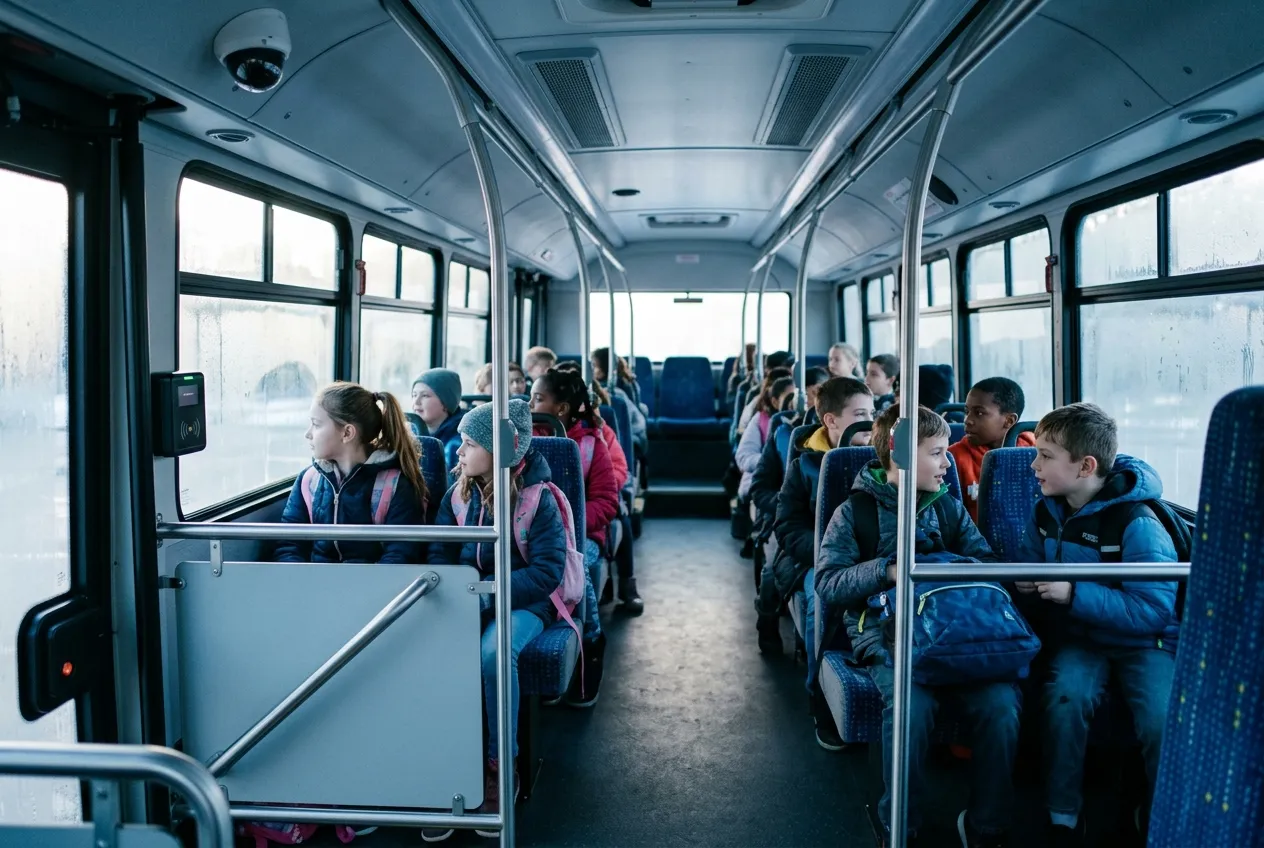
School bus tracking has been available for years, and most school transport operators already know where their buses are. The next step is more interesting: buses that understand what is happening on board and around them, and that help operators act before a small problem becomes a serious one.
The intelligent school bus
A modern school transport stack combines many capabilities on a single vehicle:
- GPS tracking and route monitoring against the planned schedule
- Student attendance through RFID, NFC or smart identification at boarding and alighting
- Parent notifications when the bus is approaching, and when a child boards or leaves
- Driver monitoring, speed and harsh-driving detection
- On-board CCTV with AI video analytics for passenger and road-facing views
- Child presence detection and digital end-of-trip verification so no child is left on board
- Geofencing, bus occupancy and emergency alerts
- Route optimisation and predictive maintenance to keep the fleet reliable
From reactive to proactive safety
The most important shift is not any single feature but the move from reactive to proactive safety. Traditional CCTV records everything and relies on someone reviewing footage after an incident. AI systems can identify risky behaviour — a driver on the phone, a child standing while the bus is moving, a door opened outside a stop — and bring it to an operator's attention while it still matters.
The school bus of the future won't just track children. It will understand what is happening inside and around the bus.
What administrators and parents gain
For transport administrators, the result is a single dashboard across routes, drivers, attendants and incidents, integrated with the school management system so rosters and notifications stay accurate. For parents, it is confidence: a clear picture of where the bus is and that their child boarded safely, delivered to their phone without anyone having to make a call.
Getting the foundations right
Intelligence depends on reliable basics. Student identification must work at every door on every trip, which means choosing readers suited to the bus layout and the age of the children. Cameras need the right coverage — a passenger-facing view, a road-facing view and, where required, external views of the door and the blind spots around the bus. Connectivity has to hold up across the whole route, including school campuses and residential areas with weak coverage, so devices should buffer and sync rather than drop events. And every alert should have a clear owner: a transport supervisor, the school's operations desk or, in an emergency, a defined escalation path.
Schools and operators in the UAE also work within regulatory requirements for vehicle tracking and surveillance, so the technology stack should be designed with approved devices and compliant data handling from the start rather than retrofitted later.
Wexoz designs and deploys school commute solutions in the UAE that bring tracking, student identification, cameras, parent communication and administration portals together — selected and integrated around each school's requirement.
Have a related requirement? Let's design the right solution for it.